$3,000.00 off any sunroom, screened room, 4-season room, or addition.
Free Ring Motion Detector w/Camera with every deck, sunroom, screened room, 4 season room, or addition.
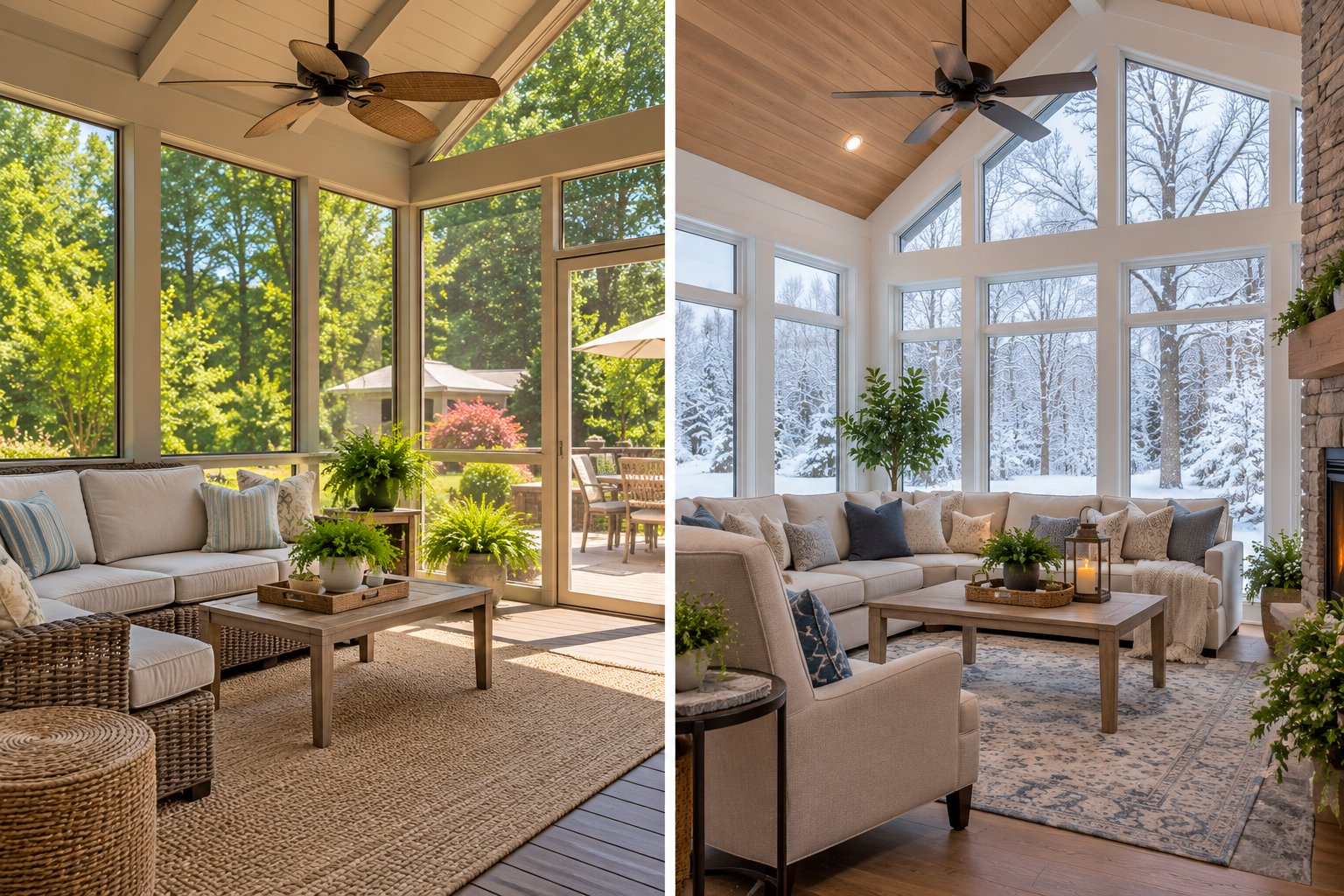
Adding a sunroom is a great way to enjoy more natural light, backyard views, and additional usable space without losing the connection to the outdoors. But before planning your project, there is an important decision to make: Should you build a four-season room or a three-season room?
Although these additions may look similar from the outside, there can be significant differences in insulation, windows, heating and cooling, construction requirements, cost, and how often you can comfortably use the space.
For Tennessee homeowners, this decision is particularly important. Hot, humid summers and cooler winter temperatures mean a room designed primarily for pleasant spring and fall weather may perform very differently from one designed for year-round comfort.
Understanding the differences between a four-season room vs. three-season room can help you make a better investment in your home.
A three-season room is an enclosed space generally intended for use during spring, summer, and fall, although actual comfort depends on the weather and the room’s design.
It typically provides more protection than a screened porch while maintaining a strong connection to the outdoors.
Common features may include:
A three-season room can protect you from rain, insects, leaves, and other outdoor conditions while still providing excellent backyard views.
However, these rooms typically aren’t insulated or climate-controlled to the same level as the main living areas of the home.
A four-season room is designed with year-round comfort in mind.
It generally incorporates more substantial construction and energy-efficiency features so the space can better handle Tennessee’s changing temperatures.
Depending on the project, a four-season room may include:
Rather than feeling primarily like an enclosed outdoor area, a well-designed four-season room can feel much closer to an extension of the home’s interior.
The main difference is how the room is designed to handle temperature and weather.
A three-season room gives you a protected environment while still being influenced significantly by outdoor temperatures.
A four-season room is designed to provide greater control over the interior environment throughout the year.
That distinction affects almost everything else, including windows, insulation, HVAC considerations, construction complexity, and overall investment.
Tennessee’s climate makes this an especially important question.
Spring and fall can offer excellent outdoor weather, making a three-season room particularly enjoyable during those periods. However, summers can become hot and humid, while winter temperatures can make an unconditioned enclosure uncomfortable.
A properly planned four-season room can provide greater flexibility.
At American Services of TN, we believe the decision should start with how you actually want to use the room. If you primarily want a protected place to enjoy pleasant weather, a three-season design may be sufficient. If you envision using the room for breakfast on cold mornings, working from home throughout the year, or relaxing during peak summer heat, a four-season design may make more sense.
The right solution depends on your home and lifestyle—not simply which option has more features.
Insulation is one of the most important distinctions between these two types of rooms.
Insulation may be limited because the room is not necessarily intended to maintain the same temperature as the home’s conditioned interior.
Insulation becomes much more important.
Depending on the construction, insulation may be incorporated into:
Proper insulation helps reduce heat transfer, making the room easier to cool during summer and heat during winter.
This is an area where construction quality matters significantly. Simply adding a heating or cooling unit cannot compensate for a poorly designed building envelope.
Because sunrooms contain so much glass, window selection can have a major effect on comfort.
A three-season room may use a window system primarily designed to provide views, ventilation, and weather protection.
For a four-season room, energy performance becomes a larger consideration.
Depending on the design, homeowners may want to consider features such as:
Window orientation matters as well.
Large west-facing windows, for example, can receive intense afternoon sunlight. The overall design may need to account for this with appropriate glass, shades, landscaping, ventilation, or roof overhangs.
Another major difference is climate control.
Three-season rooms generally aren’t intended to function exactly like the conditioned interior of the home. Ceiling fans and operable windows can improve comfort during warmer weather, while homeowners may use the room less during temperature extremes.
Four-season rooms require more careful consideration of heating and cooling.
Depending on the project, solutions might include a dedicated ductless mini-split system or another properly designed HVAC approach.
Before simply extending existing ductwork into a new room, the home’s current HVAC system should be evaluated to determine whether it can accommodate the additional load.
At American Services of TN, we encourage homeowners to consider comfort requirements during the design stage rather than treating heating and cooling as an afterthought.
A four-season room generally requires more substantial construction because it needs to perform more like an interior living environment.
The project may involve additional considerations for:
A three-season room may be less complex, depending on the design and existing structure.
However, both should still be properly designed and constructed. Weather resistance, drainage, structural integrity, and the connection to the existing house remain important regardless of the room type.
Generally, a four-season room requires a larger investment than a comparable three-season room.
The difference isn’t simply because one is “better.” A four-season room often contains more building components and higher-performance materials.
Cost can be affected by:
A smaller, straightforward project can be very different from a large custom room with premium windows and extensive interior finishes.
That’s why homeowners should be cautious about relying on generic online cost estimates.
A detailed evaluation of the home and proposed project provides a much more meaningful picture.
Both room types require maintenance, although specific needs depend on materials.
Typical maintenance can include:
A four-season room may also have heating and cooling equipment that requires routine maintenance.
Quality materials and proper installation can help reduce maintenance problems over the long term.
Sometimes—but it may be more complicated than homeowners expect.
Turning a seasonal room into a year-round space may require upgrading:
The existing foundation and structural framing may also need to be evaluated.
If you think there is a strong possibility that you’ll eventually want year-round use, discuss that with your contractor before building the original room.
Planning for future possibilities can sometimes prevent expensive reconstruction.
Homeowners frequently ask whether adding a four-season room automatically increases the official square footage of the house.
The answer depends on the construction, applicable building standards, appraisal practices, and local requirements.
Simply calling an addition a “four-season room” does not automatically make it recognized as finished living area.
If increasing recognized living space is an important goal, discuss the requirements with the appropriate professionals before finalizing your plans.
Homeowners sometimes confuse three-season rooms with screened porches.
A screened porch primarily uses screens to separate the space from the outdoors. It provides excellent airflow and insect protection but remains strongly affected by outside weather.
A three-season room generally provides more enclosure and weather protection, often through windows or flexible window-and-screen systems.
A four-season room takes the concept further by incorporating greater insulation and climate control.
You can think of the options as a progression:
Screened Porch → Three-Season Room → Four-Season Room
Each step provides greater separation from outdoor conditions, but it can also involve greater construction complexity and investment.
Both can be excellent.
A three-season room creates a relaxed environment for:
A four-season room offers similar possibilities while reducing dependence on the weather.
If you entertain frequently throughout the year, that additional flexibility may be valuable.
Consider furniture placement before finalizing the room dimensions. A dining table, lounge furniture, television, walkways, and doors can consume more space than homeowners initially expect.
Both can improve the appeal and usability of a property.
A four-season room may offer broader functionality because it can potentially be used throughout more of the year. However, that does not mean every four-season room will provide a higher financial return than every three-season room.
Value depends on factors such as:
The best addition is one that feels intentional and complements the existing home.
Ask yourself several practical questions before deciding:
How many months of the year do I want to use the room?
If spring through fall is enough, a three-season room may meet your expectations.
Do I want dependable heating and cooling?
If yes, consider a four-season design.
How will I use the space?
A casual sitting area has different requirements from a home office or everyday family room.
How important is the budget?
A three-season room may allow you to create an enjoyable protected space without some of the systems required for year-round conditioning.
Do I expect my needs to change?
If you believe you’ll eventually want a fully conditioned room, planning for that possibility early can be beneficial.
The difference between a successful sunroom and a disappointing one isn’t only the materials you select.
It is also how the entire project is planned.
At American Services of TN, we look at how the new room will interact with the existing home, including the structure, roofline, drainage, sunlight, intended use, and overall outdoor living environment.
Our goal isn’t simply to add an enclosure. It’s to help create a space that makes sense for the property and the way your family wants to use it.
That may mean a three-season room for one homeowner and a more substantial four-season addition for another.
Good design begins by choosing the right solution.
When comparing a four-season room vs. three-season room, there isn’t one answer that’s right for every Tennessee homeowner.
A three-season room can provide a comfortable connection to the outdoors while protecting you from rain, insects, and other elements during much of the year.
A four-season room offers greater insulation and temperature control, making it a better option for homeowners who want to use the space through a wider range of Tennessee weather.
The key is to decide how you want the room to function before construction begins.
At American Services of TN, we design outdoor and transitional living spaces around the home, property, and homeowner—not around a one-size-fits-all package.
Whether you’re considering a three-season room, four-season room, screened porch, deck, patio, or another outdoor living improvement, we can help you evaluate your options and determine what makes the most sense for your home.
Tell us what you want from your new space, and we’ll help you explore the right approach. Fill out the form below to request a consultation with American Services of TN.